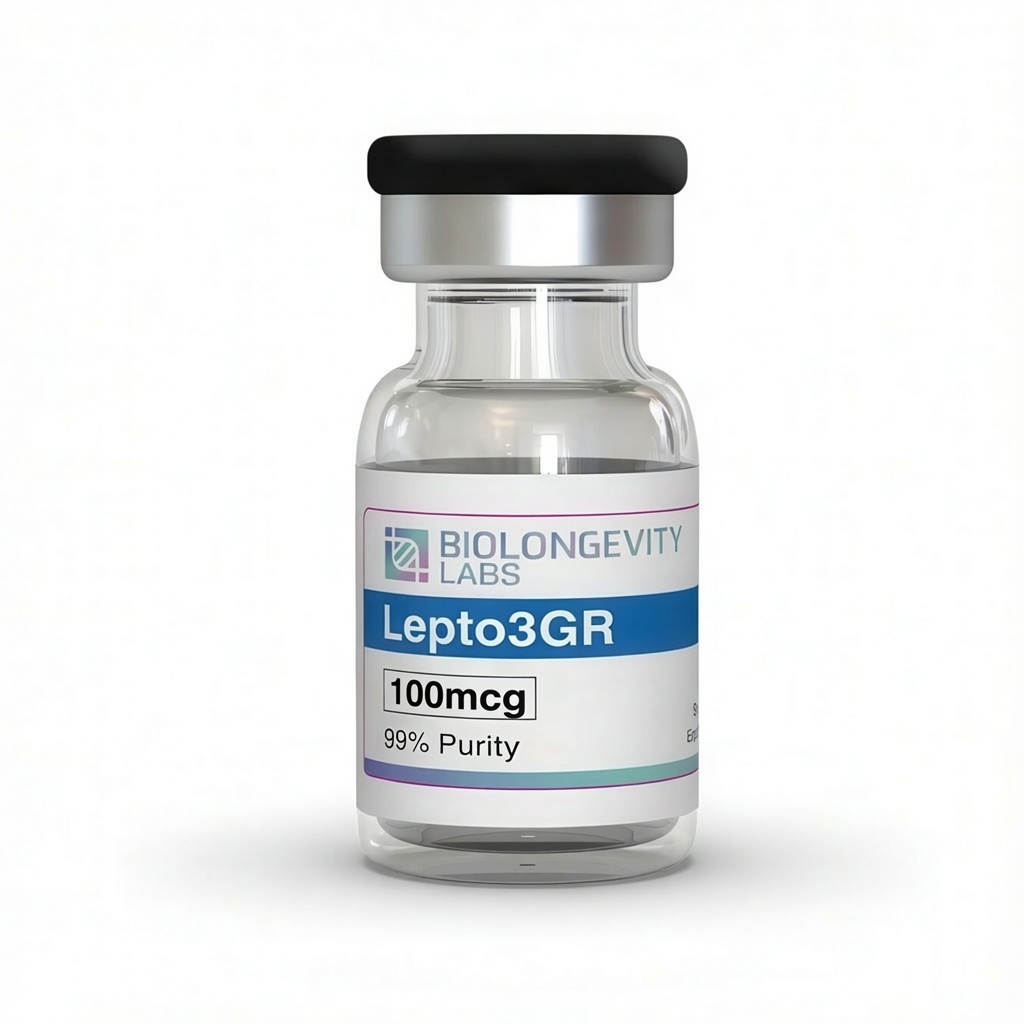
Lepto3GR Description
Lepto3GR is a research peptide built on a modified peptide backbone carrying alpha-aminoisobutyric acid and additional substitutions for enzymatic stability. At position #17, the backbone carries a patented albumin-binding attachment in place of the fatty diacid chain used in comparable triple-receptor research compounds.
The albumin binder connects to the backbone through an oligo(ethylene glycol) and gamma-glutamic acid spacer, a configuration intended to increase water solubility and reduce steric hindrance relative to fatty-acid-based binders.
In vitro binding characterization records higher measured binding affinity across the compound’s three target receptors compared with reference triple-receptor compounds assayed under matched conditions. Per-receptor binding values are held in the analytical dossier.
The albumin-binding modification is associated with an extended estimated serum stability period, which may support less frequent application intervals and lower per-application concentrations in research models.
Lepto3GR is intended for laboratory research use only.
Peptide Specifications
| Property |
Details |
| Peptide Sequence |
Tyr-Aib-Gln-Gly-Thr-Phe-Thr-Ser-Asp-Tyr-Ser-Ile-meL-Leu-Asp-Lys-Lys-Ala-Glu-Aib-Ala-Phe-Ile-Gly-Tyr-Leu-Leu-Glu-Gly-Gly-Pro-Sr-Ser-Gly-Ala-Pro-Pro-Pro-Ser-NH2 |
| Molecular Formula |
C325H497N84O106S2 |
Lyophilized Peptides:
These peptides are freeze-dried, a process that not only extends shelf life but also preserves the purity and integrity of the peptides during storage. We do not use any fillers in this process.
Product Usage:
This PRODUCT IS INTENDED AS A RESEARCH CHEMICAL ONLY. This designation allows the use of research chemicals strictly for in vitro testing and laboratory experimentation only. All product information available on this website is for educational purposes only. This product should only be handled by licensed, qualified professionals. This product is not a drug, food, or cosmetic and may not be misbranded, misused or mislabeled as a drug, food or cosmetic.
Research
Research on structurally modified peptide compounds has focused on stability, binding characteristics, and application intervals in preclinical models. Over roughly the past two decades, structural modifications to this compound class have aimed at improving stability, increasing measured binding affinity, and lowering the frequency of observed events in research models.
Lepto3GR carries three structural changes that separate it from comparable research compounds described in the literature.
Modified SA21 Albumin-Binding Peptide
The molecule incorporates a modified SA21 peptide originally developed by Dr. Mark Dennis (Genentech), with the amino acid sequence Ac-RLIEDICLPRWGCLWEDD-NH2. [1]
The original SA21 peptide shows a surface plasmon resonance (SPR) binding affinity of 468 nM to serum albumin (HSA). The modified SA21 peptide used in Lepto3GR records an SPR reading of 10 to 20 nM. [2]
This modification is intended to support higher compound concentrations within target tissues in preclinical models. It is associated with an estimated serum stability period of roughly two weeks, which may support less frequent application intervals and lower per-application concentrations.
Glycine-Serine Linker
A flexible glycine-serine (Gly-Ser) linker (GGSGGSGGSGG) bound to the C-terminus of the SA21 peptide forms the albumin binder used in Lepto3GR’s architecture.
Backbone Attachment and Enzymatic Stability
The glycine-serine linker binds to position #17 of a modified peptide backbone that carries its own amino acid substitutions. These include modification of the second backbone amino acid to alpha-aminoisobutyric acid, intended to protect the compound against cleavage by the dipeptidyl-peptidase 4 (DPP-4) enzyme.
Spacer Configuration
The backbone connects to the albumin binder through a spacer of oligo(ethylene glycol) (OEG) and gamma-glutamic acid (γ-Glu).
This configuration, similar to how fatty acid chains connect to amino acid chains in comparable research compounds, increases hydrophilicity (water solubility) and reduces the steric hindrance associated with albumin-bound fatty acid chains. [3][4]
Research Direction
Further in vitro and preclinical work will be needed to characterize downstream endpoints under study, including binding behavior across target receptors and stability characteristics in research models.
Lepto3GR is intended for laboratory research use only.
References
- Dennis MS. Serum Albumin Binding Peptides for Tumor Targeting. Genentech, Inc.; 2005. US20050287153A1. https://patents.google.com/patent/US20050287153A1
- FBR011 — Novel and Potent G-Protein Coupled Receptor Agonists (URL to be added upon publication)
- Wang S, He W, Xiao C, Tao Y, Wang X. Synthesis of Y-Shaped OEGylated Poly(amino acid)s: The Impact of OEG Architecture. American Chemical Society (ACS); 2019. https://doi.org/10.1021/acs.biomac.9b00026
- Geng C, Wang S, Wang H. Recent Advances in Thermoresponsive OEGylated Poly(amino acid)s. MDPI AG; 2021. https://doi.org/10.3390/polym13111813
Certificate of Analysis (COA) for Every Batch
A Certificate of Analysis (COA) is a document that verifies a compound’s identity, purity, and batch quality through independent laboratory testing. Every compound from BioLongevity Labs ships with a COA tied to its specific batch, so researchers can confirm exactly what they received before it enters a protocol.
Each COA reports results from third-party laboratory analysis, including:
- Ultra-high-performance liquid chromatography with mass spectrometry (UHPLC-MS) for purity, typically confirmed at 99% or higher
- Mass identification for molecular confirmation and content quantitation
- Endotoxin quantitation by Limulus amebocyte lysate (LAL) assay where applicable
- Visual and physical characterization of the finished material
How to verify a COA independently
Every certificate can be checked against the issuing laboratory’s own records, not just the copy hosted here. Verification does not depend on BioLongevity Labs.
- MDx BioAnalytical Laboratory certificates carry a QC tracking number and a search code. Newer certificates also carry a QR code. Scan the code, or enter the search code at mdxbiolabs.com, to pull the official record.
- BioRegen reports of analysis carry a Report ID and a Validation Key. Scan the QR code on the certificate to open the official record, or reference both identifiers when contacting the laboratory at the address printed on the report.
- SafeCert Labs certificates, which appear on a number of earlier batches, carry a COA number and the signature of the reporting chemist. Reference that number when requesting confirmation from the laboratory directly.
Batches are frequently tested by both laboratories independently. When two certificates exist for the same lot, each one resolves at its own issuing laboratory, which lets a researcher confirm the same material twice through two unrelated sources.
COAs are sourced from independent certified labs rather than in-house testing alone, giving researchers a verifiable record of molecular integrity for each batch. All compounds are supplied for research use only.
Review the COAs for this batch below, or browse the full COA library.
No COAs available for this product.