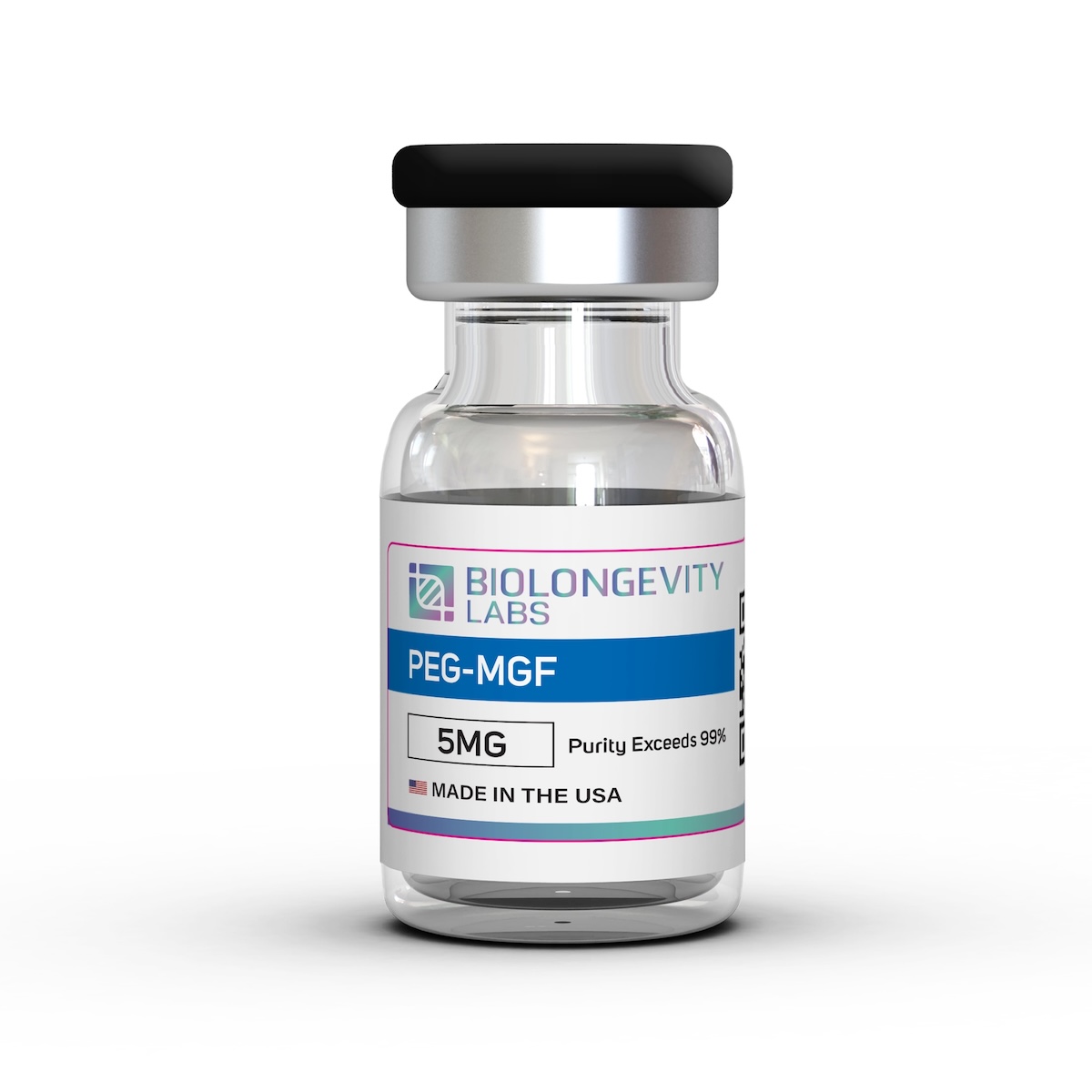
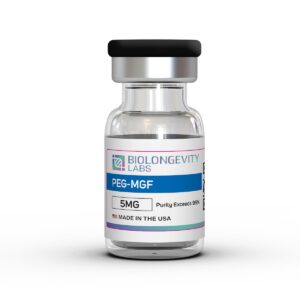
PEG-MGF Product Description
PEG MGF (Pegylated Mechano Growth Factor) is a synthetic, modified form of MGF, which is a split variant of Insulin-like Growth Factor-1 (IGF-1). Through a process called pegylation, a polyethylene glycol (PEG) molecule is attached to the MGF peptide, significantly enhancing its stability for research use.
This peptide preferentially targets recently stressed or damaged muscle cell tissue, making it particularly suited for laboratory studies investigating muscle growth, repair and recovery.
Peptide Information
| Property |
Value |
| Peptide Sequence |
PEG-Tyr-Gln-Pro-Pro-Ser-Thr-Asn-Lys-Asn-Thr-Lys-Ser-Gln-Arg-Arg-Lys-Gly-Ser-Thr-Phe-Glu-Glu-Arg-Lys |
| Molecular Formula |
C121H200N42O39 |
| Molecular Weight |
2900 g/mol |
| CAS Number |
108174-48-7 |
| PubChem CID |
178101669 |
| Synonyms |
IGF-1 Ec E-peptide, MGF-E, Pegylated MGF, PEG-MGF-Ct24E, PEG Myotrophin |
Lyophilized Peptides:
These peptides are freeze-dried, a process that not only extends shelf life but also preserves the purity and integrity of the peptides during storage. We do not use any fillers in this process.
PEG MGF Research
PEG-MGF demonstrates significant potential across multiple regenerative applications. The research explores its effectiveness in muscle repair and regeneration, bone and cartilage healing, stem cell regulation and protective effects in both neural and cardiac tissues.
Musculoskeletal Regeneration and Muscle Repair
MGF has been shown to enhance satellite cell activation, proliferation, and fusion in human muscle progenitor cells. The peptide can delay cellular senescence and improve muscle repair, suggesting potential for combating age-related muscle loss and improving myogenic precursor cell transplantation outcomes in conditions like Duchenne muscular dystrophy.[1]
Bone and Cartilage Repair
MGF promotes osteoblast proliferation, differentiation, and mineralization, and significantly enhance bone defect healing in animal models.[2]
In cartilage repair, MGF combined with TGF-β3 in silk fibroin scaffolds increases stem cell recruitment and chondrogenic differentiation, leading to improved articular cartilage regeneration and integration in rabbit models.[3]
Stem Cell Migration and Differentiation
MGF E peptides regulate the migration and differentiation of bone marrow mesenchymal stem cells (BMSCs). While they do not affect BMSC proliferation, they enhance migration and shift differentiation toward adipogenesis over osteogenesis, mediated via the IGF1 receptor and Erk1/2 signaling pathway.[4]
Neuroprotection and Cardiac Repair
The C-terminal peptide of MGF demonstrates strong neuroprotective effects in models of brain ischemia, functioning independently of the IGF-1 receptor and providing prolonged neuronal protection compared to full-length IGF-1.[5] In cardiac tissue, localized delivery of the MGF E-domain peptide via polymeric microstructures after myocardial infarction improves cardiac function, reduces mortality, and prevents adverse remodeling.[6]
References
- Kandalla, P., Goldspink, G., Butler-Browne, G., & Mouly, V. (2011). Mechano Growth Factor E peptide (MGF-E), derived from an isoform of IGF-1, activates human muscle progenitor cells and induces an increase in their fusion potential at different ages. Mechanisms of Ageing and Development, 132, 154-162. https://doi.org/10.1016/j.mad.2011.02.007.
- Wei, W., Liu, S., Song, J., Feng, T., Yang, R., Cheng, Y., Li, H., & Hao, L. (2020). MGF-19E peptide promoted proliferation, differentiation and mineralization of MC3T3-E1 cell and promoted bone defect healing.. Gene, 144703 . https://doi.org/10.1016/j.gene.2020.144703.
- Luo, Z., Jiang, L., Xu, Y., Li, H., Xu, W., Wu, S., Wang, Y., Tang, Z., Lv, Y., & Yang, L. (2015). Mechano growth factor (MGF) and transforming growth factor (TGF)-β3 functionalized silk scaffolds enhance articular hyaline cartilage regeneration in rabbit model.. Biomaterials, 52, 463-75 . https://doi.org/10.1016/j.biomaterials.2015.01.001.
- Cui, H., Yi, Q., Feng, J., Yang, L., & Tang, L. (2014). Mechano growth factor E peptide regulates migration and differentiation of bone marrow mesenchymal stem cells.. Journal of molecular endocrinology, 52 2, 111-20 . https://doi.org/10.1530/JME-13-0157.
- Dłużniewska, J., Sarnowska, A., Beręsewicz, M., Johnson, I., Srai, S., Ramesh, B., Goldspink, G., Górecki, D., & Zabłocka, B. (2005). A strong neuroprotective effect of the autonomous C‐terminal peptide of IGF‐1 Ec (MGF) in brain ischemia. The FASEB Journal, 19. https://doi.org/10.1096/fj.05-3786fje.
- Peña, J., Pinney, J., Ayala, P., Desai, T., & Goldspink, P. (2015). Localized delivery of mechano-growth factor E-domain peptide via polymeric microstructures improves cardiac function following myocardial infarction.. Biomaterials, 46, 26-34 . https://doi.org/10.1016/j.biomaterials.2014.12.050.
Certificate of Analysis (COA) for Every Batch
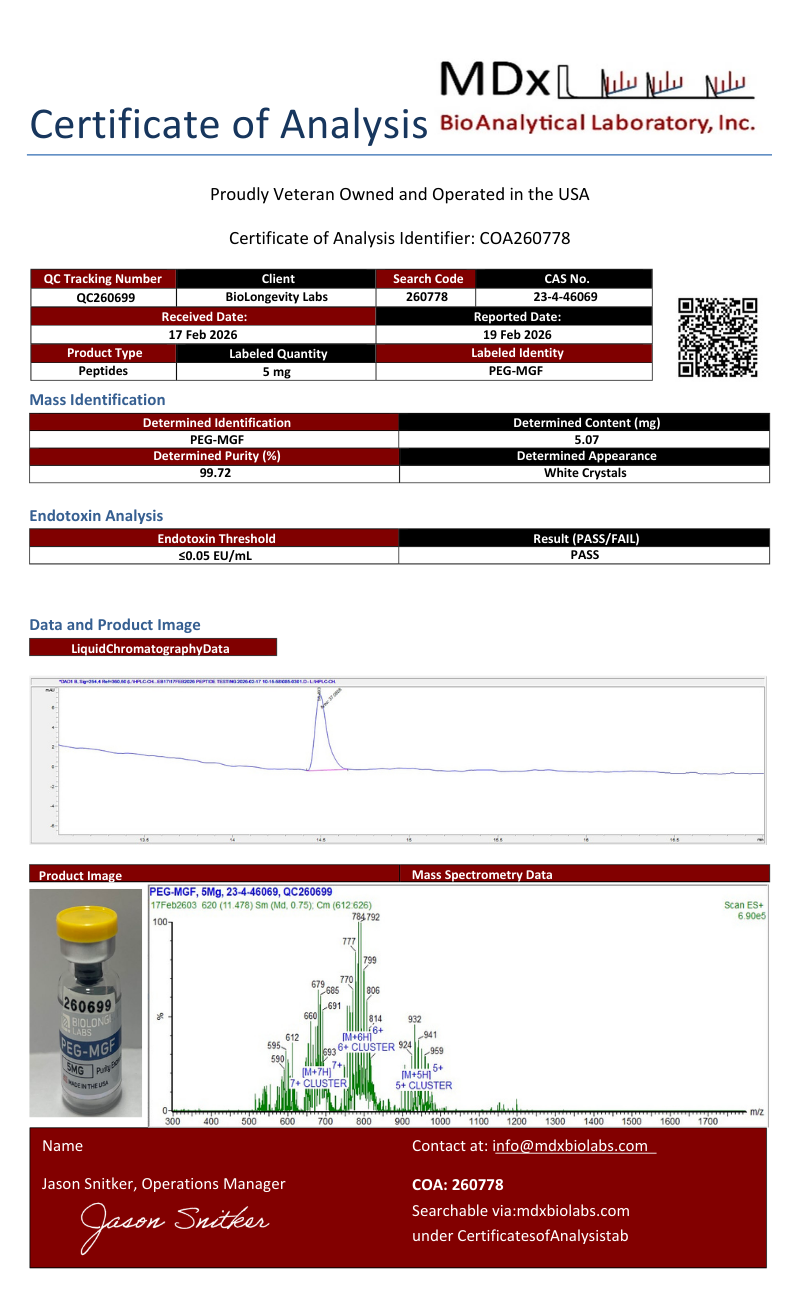
A Certificate of Analysis (COA) is a document that verifies a compound’s identity, purity, and batch quality through independent laboratory testing. Every compound from BioLongevity Labs ships with a COA tied to its specific batch, so researchers can confirm exactly what they received before it enters a protocol.
Each COA reports results from third-party laboratory analysis, including:
- Ultra-high-performance liquid chromatography with mass spectrometry (UHPLC-MS) for purity, typically confirmed at 99% or higher
- Mass identification for molecular confirmation and content quantitation
- Endotoxin quantitation by Limulus amebocyte lysate (LAL) assay where applicable
- Visual and physical characterization of the finished material
How to verify a COA independently
Every certificate can be checked against the issuing laboratory’s own records, not just the copy hosted here. Verification does not depend on BioLongevity Labs.
- MDx BioAnalytical Laboratory certificates carry a QC tracking number and a search code. Newer certificates also carry a QR code. Scan the code, or enter the search code at mdxbiolabs.com, to pull the official record.
- BioRegen reports of analysis carry a Report ID and a Validation Key. Scan the QR code on the certificate to open the official record, or reference both identifiers when contacting the laboratory at the address printed on the report.
- SafeCert Labs certificates, which appear on a number of earlier batches, carry a COA number and the signature of the reporting chemist. Reference that number when requesting confirmation from the laboratory directly.
Batches are frequently tested by both laboratories independently. When two certificates exist for the same lot, each one resolves at its own issuing laboratory, which lets a researcher confirm the same material twice through two unrelated sources.
COAs are sourced from independent certified labs rather than in-house testing alone, giving researchers a verifiable record of molecular integrity for each batch. All compounds are supplied for research use only.
Review the COAs for this batch below, or browse the full COA library.
PEG-MGF (260699)
×
![]()