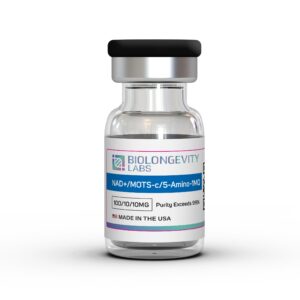
NAD+ / MOTS-c / 5-Amino-1MQ Peptide Blend Description
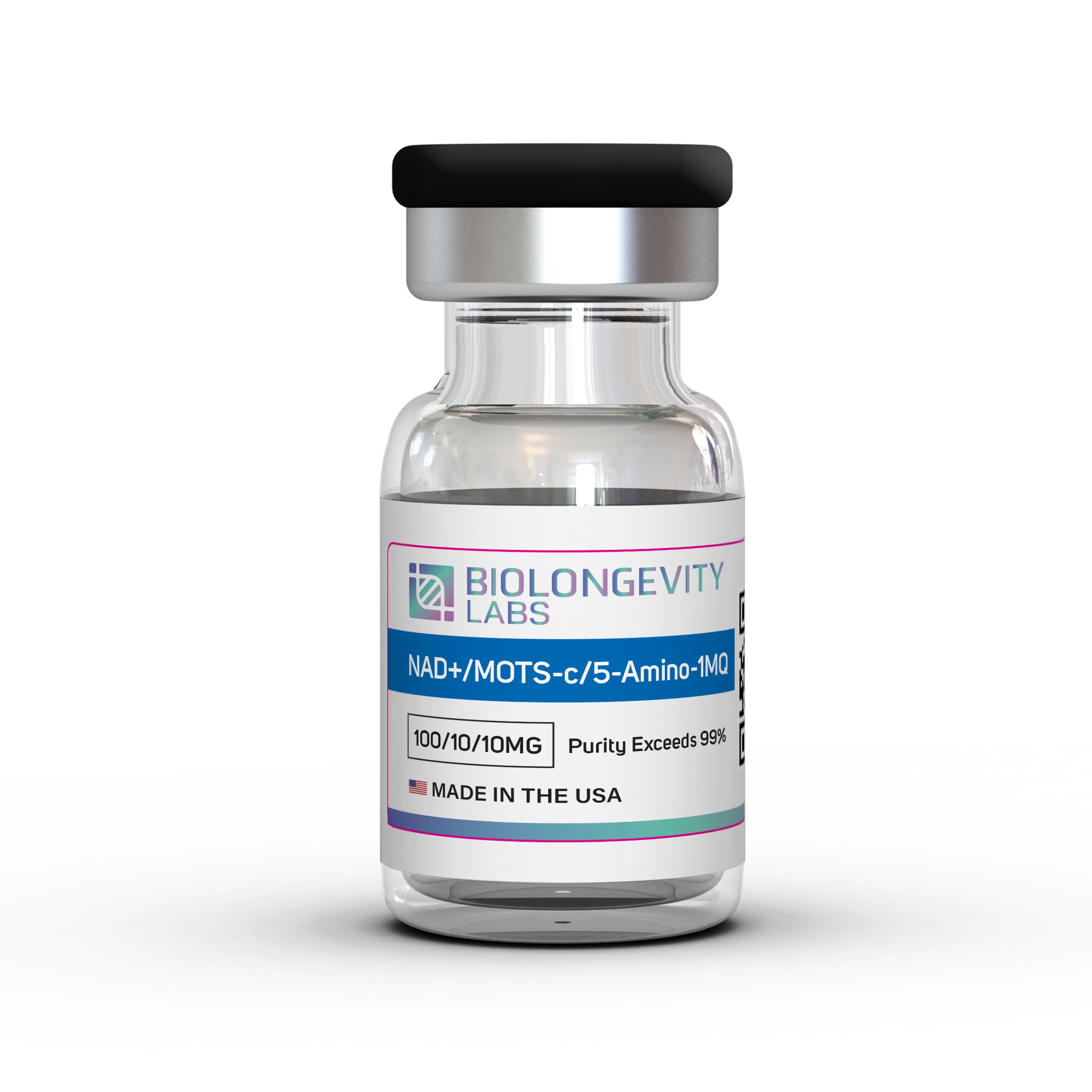
The BioLongevity Labs NAD+/MOTS-c/5-Amino-1MQ Blend unites three distinct compounds that converge on cellular energy, mitochondrial function, and metabolic regulation:
- NAD+ (100 mg) replenishes the central redox cofactor required for metabolism, DNA repair, and sirtuin activation [1][2][3].
- MOTS-c (10 mg) is a mitochondria-derived peptide that activates AMPK, regulates nuclear gene expression under metabolic stress, and enhances insulin sensitivity [4][5][6].
- 5-Amino-1MQ (10 mg) inhibits NNMT, raising NAD+ levels while modulating histone methylation and fat metabolism pathways [7][8][9].
Together, their mechanisms are designed to:
- Enhance mitochondrial and cellular energy balance by restoring NAD+ pools and activating AMPK [1][4][7].
- Improve metabolic health by reducing adiposity, sustaining muscle function, and optimizing glucose regulation [2][5][8].
- Support cognitive and longevity research through effects on neuroinflammation, oxidative stress, and cellular senescence [3][6][9].
Peptide Structures
NAD+ (Nicotinamide Adenine Dinucleotide)
- Molecular Formula: C₂₁H₂₇N₇O₁₄P₂
- Molecular Weight: 663.43 g/mol
- PubChem CID: 925
- CAS Number: 53-84-9
- Synonyms: β-Nicotinamide adenine dinucleotide, DPN, Coenzyme I, Diphosphopyridine nucleotide
MOTS-c (Mitochondrial Open Reading Frame of the 12S rRNA-c)
- Sequence: Met-Arg-Trp-Gln-Glu-Met-Gly-Tyr-Ile-Phe-Tyr-Pro-Arg-Lys-Leu-Arg
- Molecular Formula: C₁₀₁H₁₅₂N₂₈O₂₂S₂
- Molecular Weight: 2174.6 g/mol
- PubChem SID: 255386757
- CAS Number: 1627580-64-6
- Synonyms: Human MOTS-c, UNII-A5CV6JFB78, MOTS-c trifluoroacetate salt
5-Amino-1MQ (5-Amino-1-methylquinolinium)
- Molecular Formula: C₁₀H₁₁N₂
- Molecular Weight: 159.21 g/mol
- PubChem CID: 950107
- CAS Number: —
- Synonyms: 5-amino-1-methylquinolinium, SCHEMBL6403148, CHEMBL4116828, ZMJBCEIHNOWCMC-UHFFFAOYSA-O, STL196667
This synergistic triad provides a unique investigational platform for metabolism, neuroprotection, and healthy aging research.
Blend Structure
| Ingredient |
Dose (per capsule) |
Key Actions |
| NAD+ |
100 mg |
Cofactor in redox metabolism; activates sirtuins & AMPK; supports DNA repair & mitochondrial biogenesis [1][2][3] |
| MOTS-c |
10 mg |
Mitochondria-encoded peptide; AMPK activation; improves insulin sensitivity; prevents metabolic dysfunction [4][5][6] |
| 5-Amino-1MQ |
10 mg |
NNMT inhibitor; ↑NAD+; ↓adiposity; epigenetic modulation; metabolic & oncology research [7][8][9] |
Research Areas
- Cellular Energy & Mitochondrial Function
- Metabolic Regulation & Obesity Research
- Muscle Preservation & Physical Performance
- Neuroprotection & Cognitive Function
- Longevity & Anti-Aging Mechanisms
- Preclinical Cancer Research
NAD+/MOTS-c/5-Amino-1MQ Peptide Blend Research
Cellular Energy & Mitochondrial Function
NAD+ plays a vital role in redox reactions and sirtuin activation. Restoring NAD+ levels in aging and metabolic stress models improved glucose tolerance, mitochondrial function, and overall health [1]. MOTS-c translocates to the nucleus during metabolic stress to regulate antioxidant and glucose metabolism genes via AMPK activation [4]. 5-Amino-1MQ further boosts NAD+ by inhibiting NNMT, enhancing redox balance and mitochondrial efficiency [7].
Metabolic Regulation & Obesity Research
NAD+ depletion contributes to obesity and metabolic disorders; replenishment strategies improve metabolic homeostasis [2]. MOTS-c prevents diet-induced obesity and insulin resistance by improving glucose utilization and maintaining adipose homeostasis [5]. 5-Amino-1MQ reduces white adipose tissue and body weight in preclinical obesity models without affecting appetite, highlighting its direct metabolic actions [8].
Neuroprotection & Longevity
NAD+ enhancement has been shown to reduce neuroinflammation and improve cognition in models of neurodegeneration [3]. MOTS-c enhances memory formation and protects against neuroinflammation, with benefits observed in Alzheimer’s and metabolic dysfunction models [6]. 5-Amino-1MQ alters histone methylation and metabolic programs in cancer and aging models, representing a promising target for longevity and oncology research [9].
References
NAD+
- Rajman L, et al. Cell Metab. 2018. Therapeutic potential of NAD-boosting molecules in vivo. https://doi.org/10.1016/j.cmet.2018.02.011
- Okabe K, et al. J Biomed Sci. 2019. Altered NAD+ metabolism in metabolic disorders. https://doi.org/10.1186/s12929-019-0527-8
- Zhao Y, et al. J Neuroinflammation. 2021. NAD+ improves cognition via Sirt1/PGC-1α. https://doi.org/10.1186/s12974-021-02250-8
MOTS-c
- Kim K, et al. Cell Metab. 2018. MOTS-c translocates to the nucleus during metabolic stress. https://doi.org/10.1016/j.cmet.2018.06.008
- Lu H, et al. J Mol Med. 2019. MOTS-c regulates adipose homeostasis and prevents metabolic dysfunction. https://doi.org/10.1007/s00109-018-01738-w
- Lee C, et al. Cell Metab. 2015. MOTS-c promotes metabolic homeostasis and reduces obesity/insulin resistance. https://doi.org/10.1016/j.cmet.2015.02.009
5-Amino-1MQ
- Conlon N, Ford D. Biochem Pharmacol. 2022. Systems approach to NAD+ restoration via NNMT inhibition. https://doi.org/10.1016/j.bcp.2022.114946
- Liu J, et al. Biomed Res Int. 2021. NNMT inhibition reduces obesity and diabetes risk. https://doi.org/10.1155/2021/9924314
- Li X, et al. Front Oncol. 2022. NNMT as a biomarker and target in cancer. https://doi.org/10.3389/fonc.2022.894744
Note: This product is supplied strictly for investigational research use only.
Certificate of Analysis (COA) for Every Batch
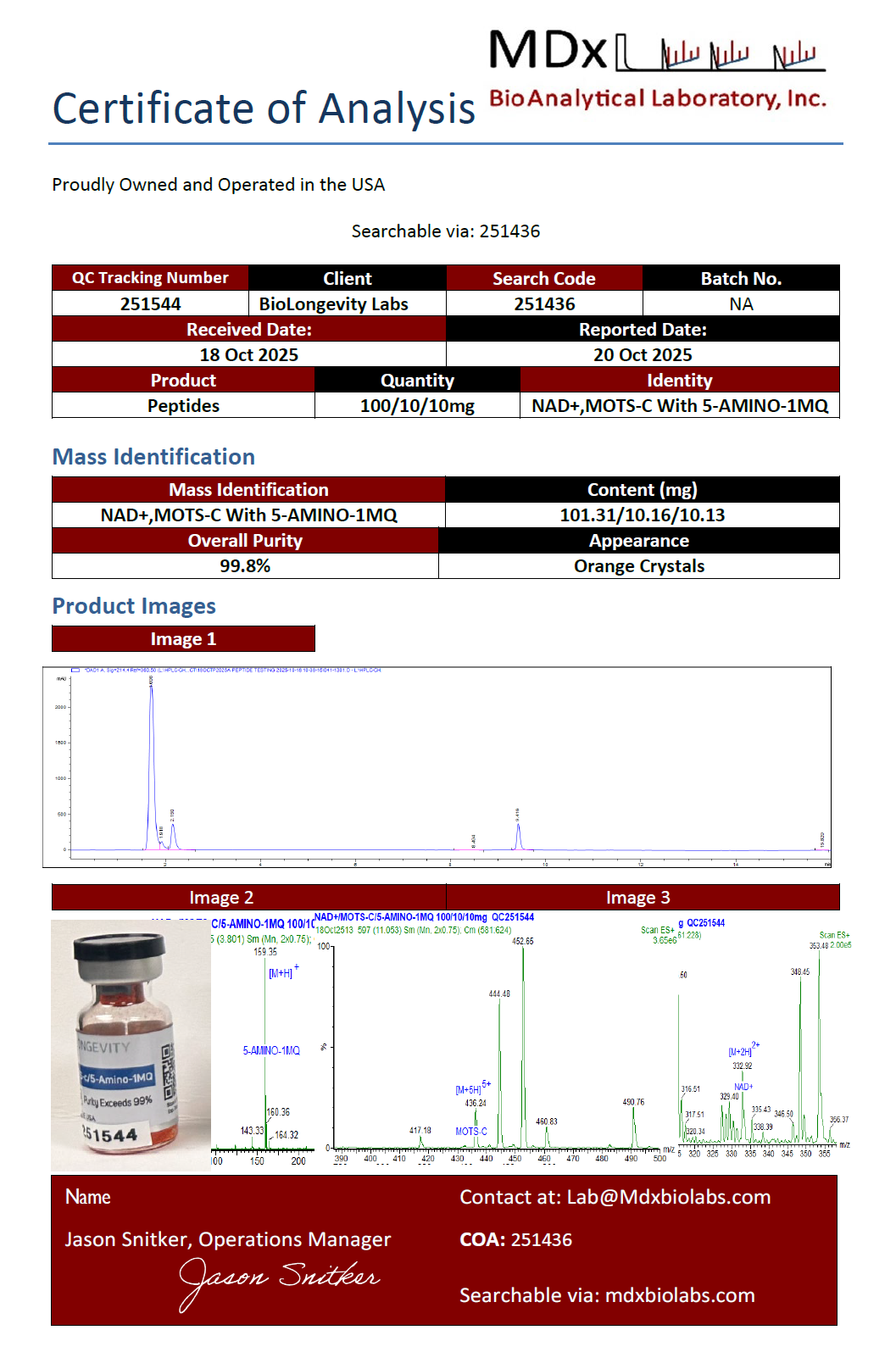
A Certificate of Analysis (COA) is a document that verifies a compound’s identity, purity, and batch quality through independent laboratory testing. Every compound from BioLongevity Labs ships with a COA tied to its specific batch, so researchers can confirm exactly what they received before it enters a protocol.
Each COA reports results from third-party laboratory analysis, including:
- Ultra-high-performance liquid chromatography with mass spectrometry (UHPLC-MS) for purity, typically confirmed at 99% or higher
- Mass identification for molecular confirmation and content quantitation
- Endotoxin quantitation by Limulus amebocyte lysate (LAL) assay where applicable
- Visual and physical characterization of the finished material
How to verify a COA independently
Every certificate can be checked against the issuing laboratory’s own records, not just the copy hosted here. Verification does not depend on BioLongevity Labs.
- MDx BioAnalytical Laboratory certificates carry a QC tracking number and a search code. Newer certificates also carry a QR code. Scan the code, or enter the search code at mdxbiolabs.com, to pull the official record.
- BioRegen reports of analysis carry a Report ID and a Validation Key. Scan the QR code on the certificate to open the official record, or reference both identifiers when contacting the laboratory at the address printed on the report.
- SafeCert Labs certificates, which appear on a number of earlier batches, carry a COA number and the signature of the reporting chemist. Reference that number when requesting confirmation from the laboratory directly.
Batches are frequently tested by both laboratories independently. When two certificates exist for the same lot, each one resolves at its own issuing laboratory, which lets a researcher confirm the same material twice through two unrelated sources.
COAs are sourced from independent certified labs rather than in-house testing alone, giving researchers a verifiable record of molecular integrity for each batch. All compounds are supplied for research use only.
Review the COAs for this batch below, or browse the full COA library.
NAD+ / MOTS-c / 5-Amino-1MQ (251544)
×
![]()